 FPS · 1080p
See it from the inside
You are the nurse.
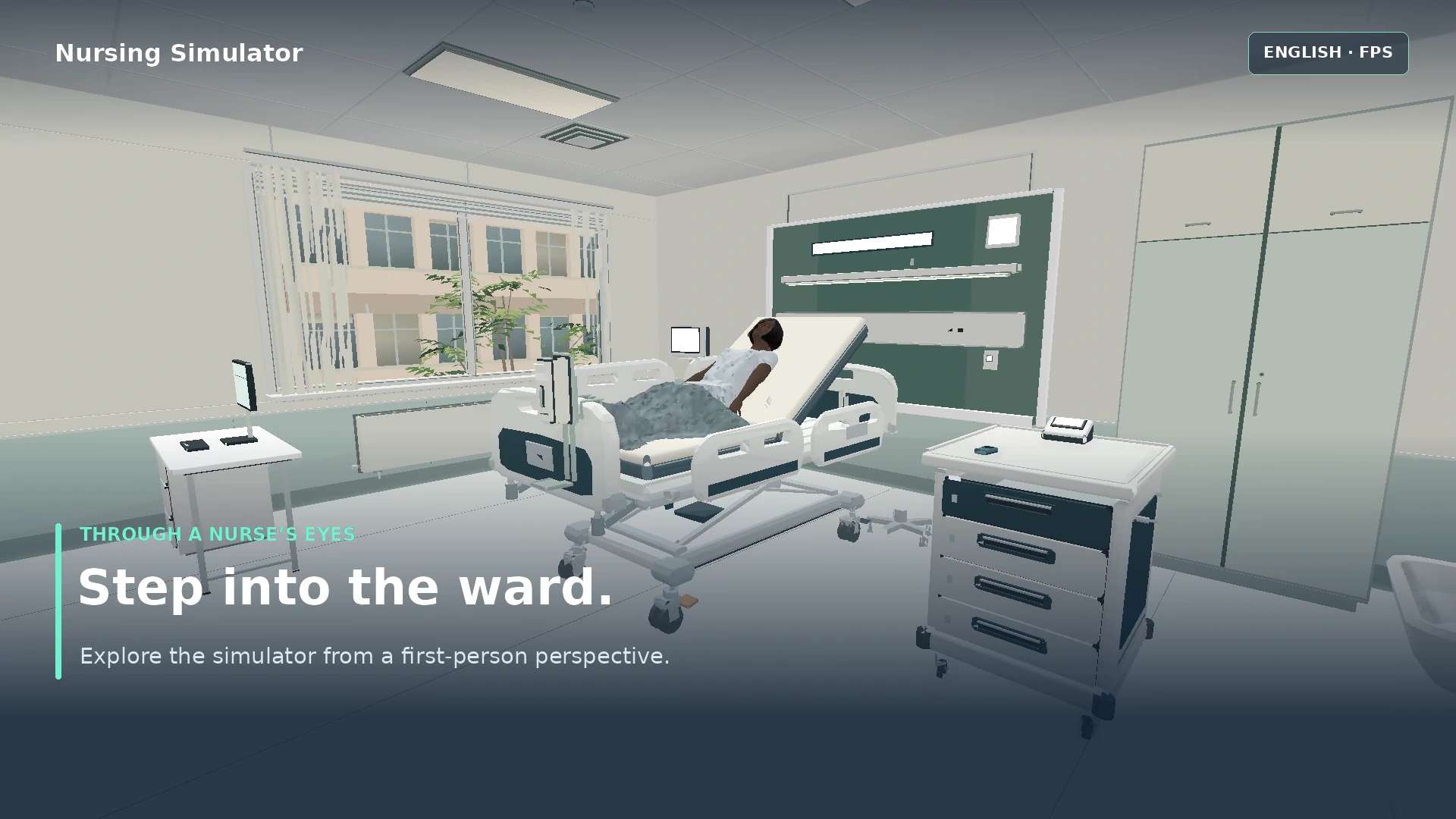
Step into the ward, look around from the nurse’s perspective and explore the places where you will practise.
English narration and captions
Watch the first-person trailer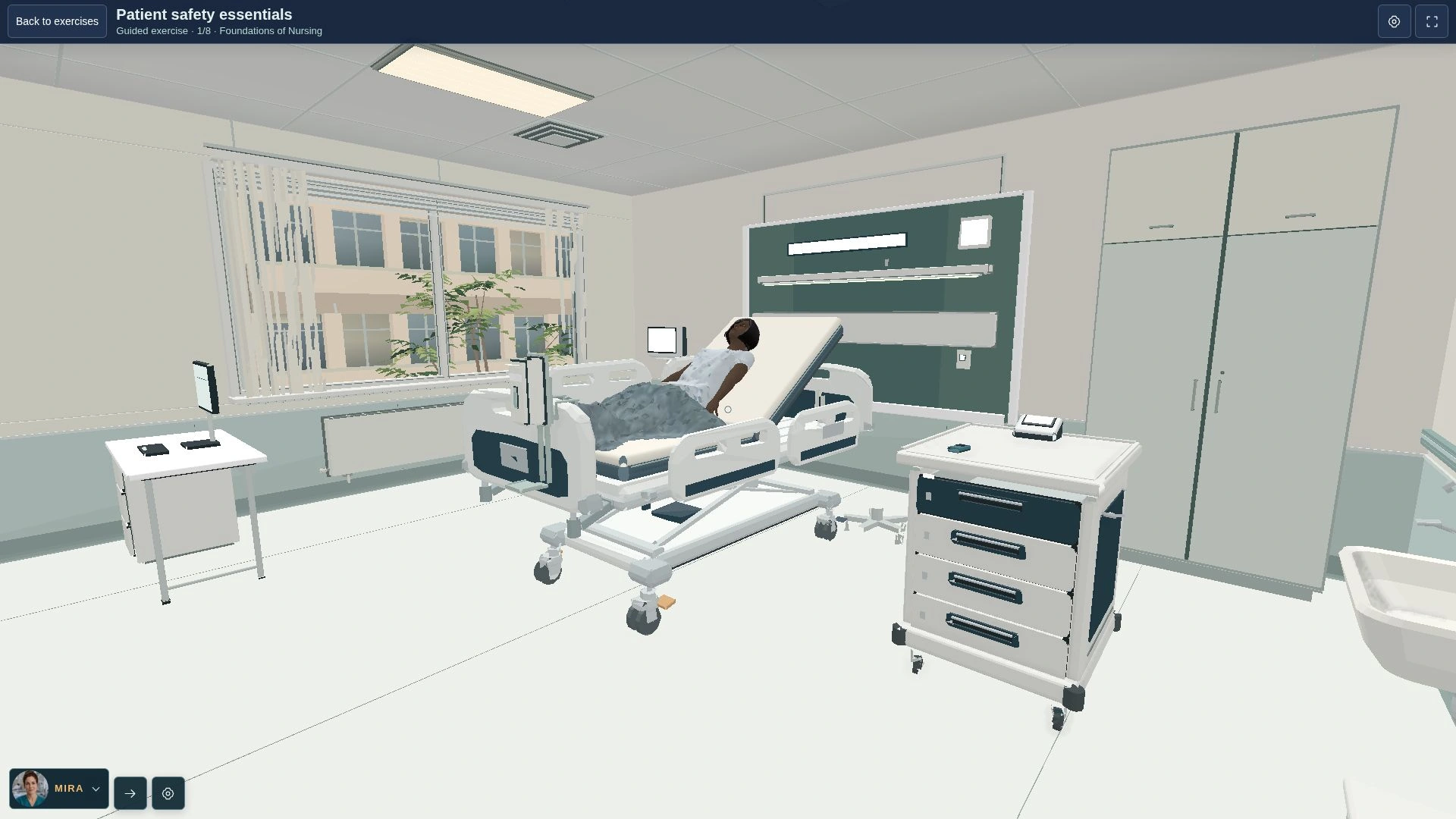
Nursing Learning Simulator
Turn nursing knowledge into practice.
Step into the ward as a nurse. Assess your patient, prepare your instruments and carry out each stage of care yourself.
Play in your browser · HU / EN / DE
Gameplay
Walk around the bed and move between the patient and the washbasin. Perform the procedure in a close-up view, then return to free movement.
FPS · 1080pSee it from the inside
Step into the ward, look around from the nurse’s perspective and explore the places where you will practise.
English narration and captions
Watch the first-person trailer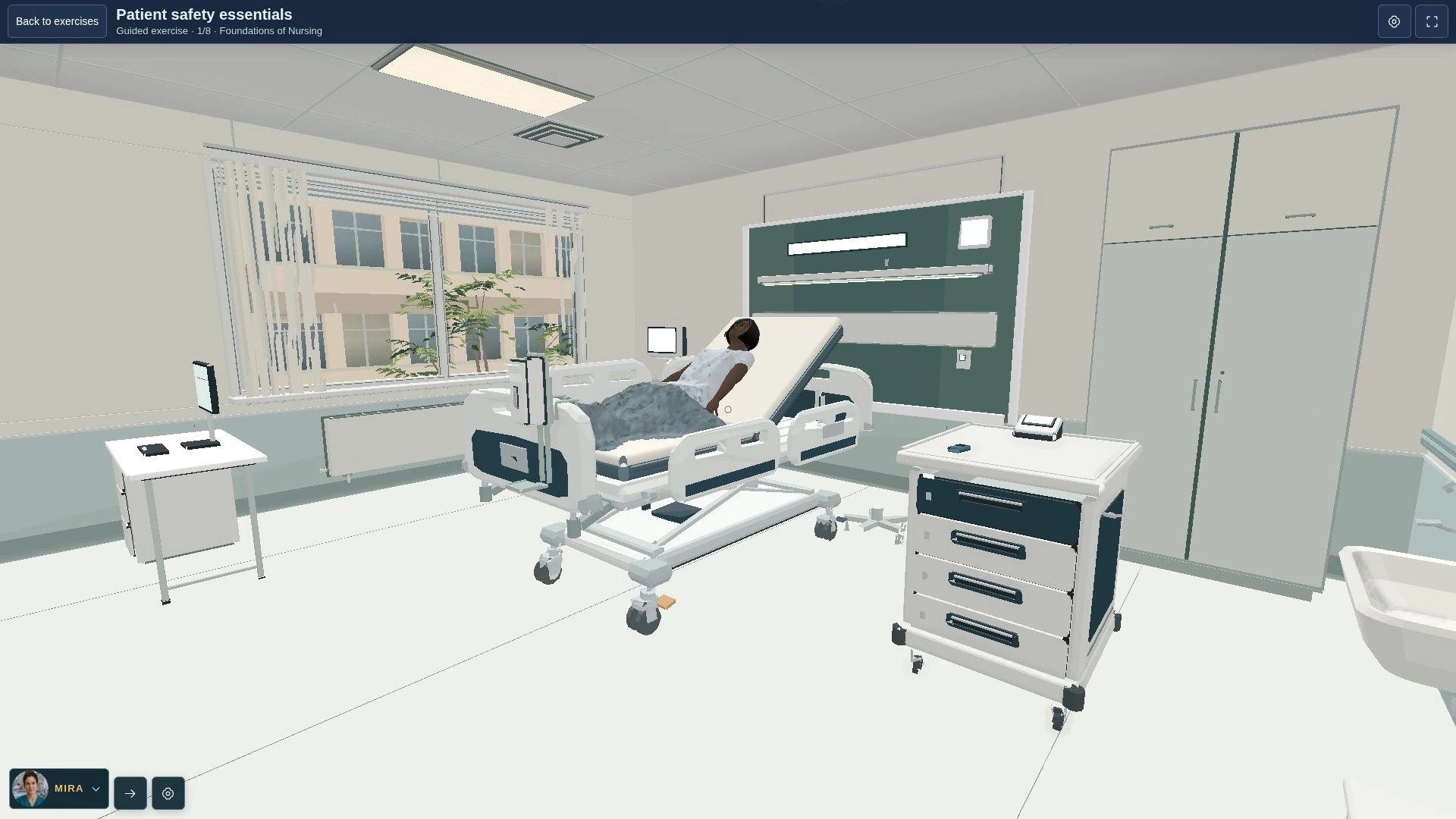
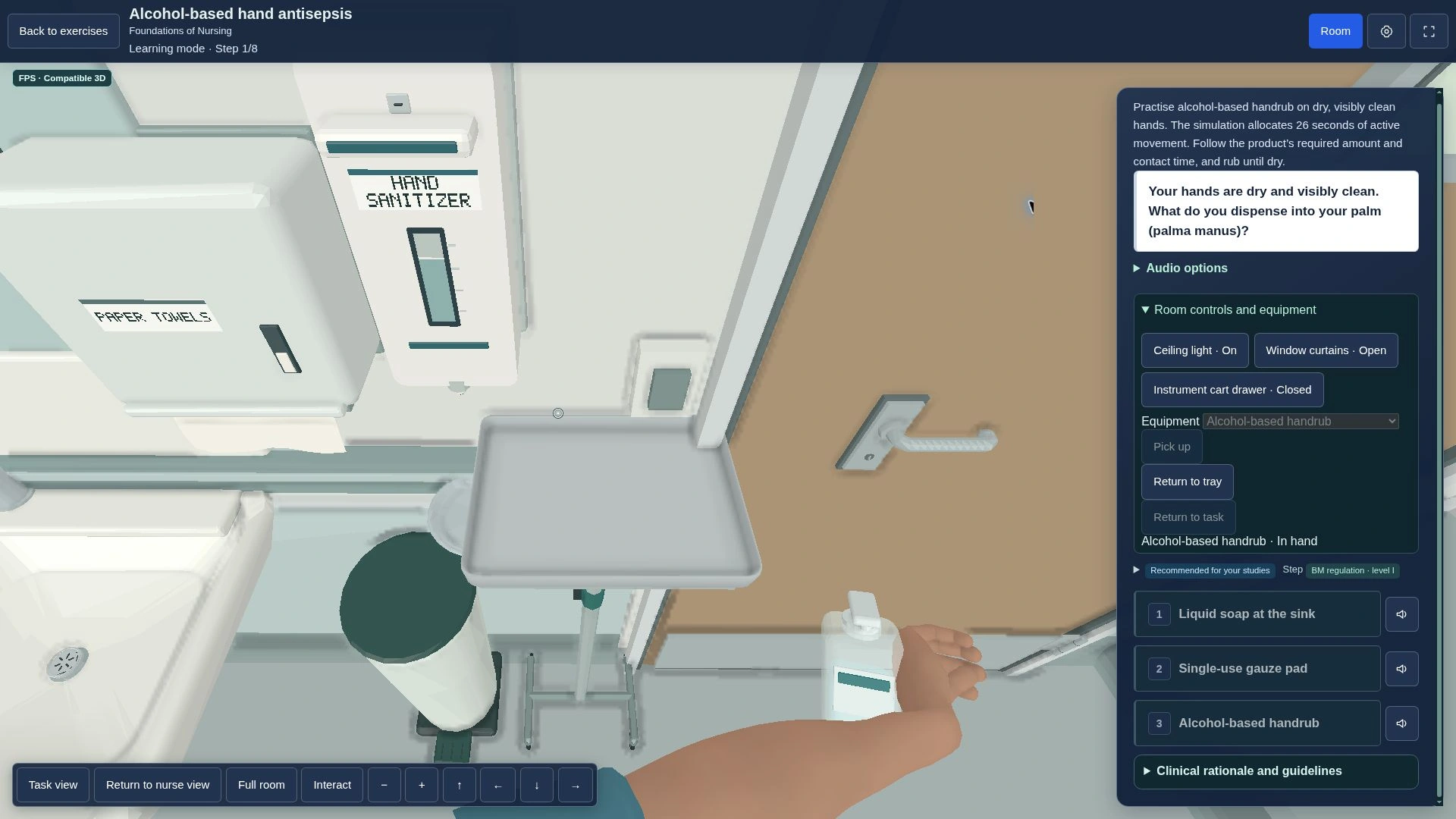
From measuring blood pressure to a four-patient triage shift. Search all 100 distinct scenarios or browse by specialty.
Ophthalmology (0) · Otolaryngology (0) · Dermatology (1) · Urology (6) · Orthopaedics and Musculoskeletal Care (1)
Practise alcohol-based handrub on dry, visibly clean hands. The simulation allocates 26 seconds of active movement. Follow the product’s required amount and contact time, and rub until dry.
Related specialtiesClosed-system collection. The laboratory requests serum and EDTA tubes. An infusion is running in the right arm.
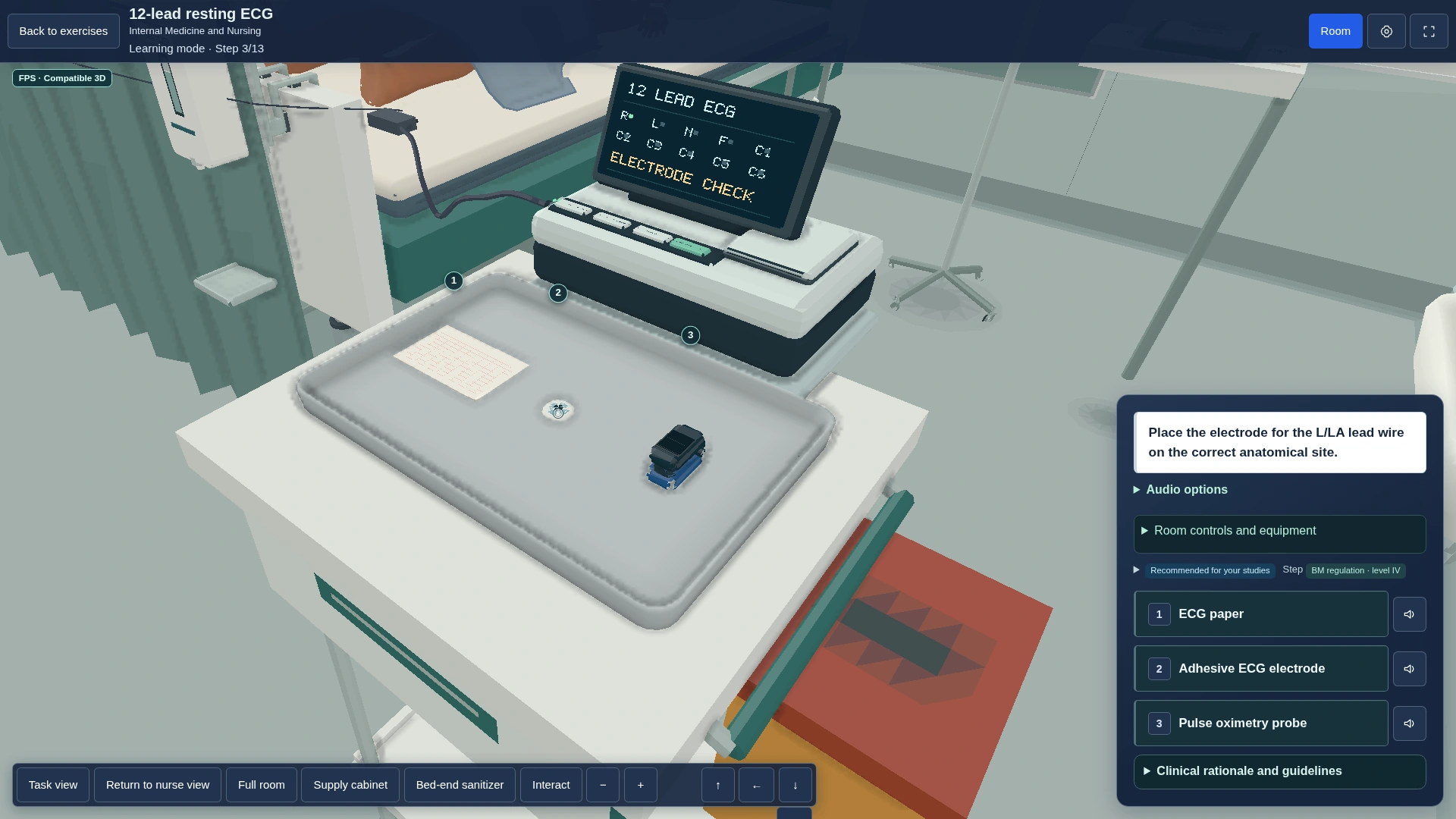
Related specialtiesAcquire a 12-lead resting ECG. Place all ten electrodes on the patient, then verify and record the trace.
Related specialtiesAn adult deteriorates shortly after an antibiotic infusion starts. Recognise anaphylaxis, call the team, start emergency treatment and reassess the patient.
Related specialtiesResting blood pressure measurement in a stable, alert adult. Cuff selection, positioning and checks matter more than speed.
Related specialtiesTake a shift in emergency triage. Meet the arriving patients, assess their condition, choose a priority and hand over their care. Approach the patient to talk and the monitor to take readings. You can hand over care at the patient’s side or at the desk.
This demo uses the WHO, ICRC and MSF three-colour IITT for routine emergency care. Red requires immediate attention, yellow requires prompt assessment, and green can wait with reassessment. Hungary uses the five-level MSTR. There is no direct conversion between the two systems.
Related specialtiesClean the counter and cabinets, check medicines and sterile supplies, and replace both empty wall dispenser cartridges.
Related specialtiesGet ready for a ward shift. Select your uniform, work shoes, official name badge, fob watch and observation-chart pen. Check that your hands are ready for hand hygiene and identify the protective equipment needed for your next task.
Related specialtiesAssist an alert adult with dysphagia at lunch. The individual plan specifies IDDSI Level 4 puréed food. Check the texture, support the patient’s pace and respond to a new swallowing symptom.
Related specialtiesHelp an alert, thirsty patient with an individual plan for supervised drinking of IDDSI Level 2 mildly thick fluids from an open cup. Verify the flow, assist with single sips and record actual fluid intake.
Related specialtiesA bedbound patient needs help with bowel elimination. Assist with a bedpan using two carers and preserving privacy, then provide aftercare and hand over the device for reprocessing.
Related specialtiesThe patient wants to pass urine in bed and can hold the urinal himself. Help him get comfortable, give him privacy, then measure and document his urine output.
Related specialtiesThe previous patient has left. Bag the used linen, clean and disinfect approved surfaces, then make the bed with fresh linen.
Related specialtiesThe patient cannot yet sit out of bed. Turn them with a second carer, replace the damp linen in two stages and restore a safe position.
Related specialtiesThe patient turns independently to either side and can maintain side lying. One nurse supervises the turns and changes the damp sheet in two stages.
Related specialtiesAssist a patient with reduced mobility to sit up gradually as planned. Record supine observations, guard the patient at the bed edge and assess the seated reading alongside symptoms.
Related specialtiesThe patient is at the bed edge and can take short transfer steps. Prepare the wheelchair, check symptoms and guard the transfer and seated position.
Related specialtiesThe patient has reported dizziness on standing. Guard each change in position, take supine and standing readings and respond to a new symptom.
Related specialtiesThe patient is returning to bed from a wheelchair. Guard the transfer and controlled return to lying, then check positioning and leave the call bell within reach.
Related specialtiesThe patient is resting in bed. A drink has dried on the overbed table. Prepare the table and removable tray, then return the clean, dry tray to storage after use.
Related specialtiesPrepare an empty bed between patients. Handle the linen, inspect the mattress and work through touch points, the frame and lower fittings.
Related specialtiesReprocess a kidney basin used to collect body fluid in the designated dirty utility room. Practise keeping the dirty and clean phases separate.
Related specialtiesCarry the used bedpan to the dirty utility room under cover. Load the pan and its lid into their separate holders, run the appropriate programme and check the cycle and the equipment.
Related specialtiesTransfer a patient who cannot stand from bed to wheelchair. Practise fitting a full-body sling, pausing under partial load and lowering safely.
Related specialtiesWith two caregivers, reposition the patient up the same bed using a handled friction-reducing slide sheet. Practise inserting the sheet, the coordinated movement and removal.
Related specialtiesTransfer a supine patient between adjacent braked stretchers using a roller board designed for lateral transfers and a pull sheet.
Related specialtiesPractise fitting an air-assisted transfer mattress, connecting the air supply, guiding the lateral transfer and deflating on the receiving stretcher.
Related specialtiesSelect, put on and remove the appropriate PPE in a case requiring droplet precautions and protection from splashes.
Related specialtiesPrepare a clean workspace, open the sterile pack and practise touching the correct glove surfaces for an aseptic task.
Related specialtiesPlace a short peripheral IV in an adult, from assessing the site through securement and patency checks.
Related specialtiesYou assist with a planned adult procedure. The physician inserts the central venous catheter. You prepare the patient and equipment, protect the sterile field, monitor the patient and document care.
Related specialtiesThe team plans 12 days of an IV antibiotic suitable for peripheral administration. Follow the patient through device selection and care of an upper-arm midline. Insertion is available in the simulated role of a credentialed vascular access nurse.
Related specialtiesThe patient needs several weeks of parenteral nutrition that requires central administration. Assist with PICC preparation, check clearance for use and recognise possible catheter migration.
Related specialtiesThe patient arrives for cancer treatment with an implanted chest (thorax) port. In the role of a trained, authorised port nurse, prepare and access the device, then respond to a change during treatment.
Related specialtiesA double-lumen cuffed Hickman catheter in an adult has a healing exit site. Replace the loose dressing aseptically, prepare the prescribed lumen and respond to any change in the patient’s condition.
Related specialtiesAn authorised clinician takes an arterial blood gas sample. As the nurse, prepare the patient and sampling equipment, help achieve haemostasis and handle the sample.
Related specialtiesAssist with left radial arterial cannulation, set up closed pressure monitoring, and detect and escalate a change in hand perfusion.
Related specialtiesCheck a peripheral IV before use, then remove it once there is no longer an indication.
Related specialtiesTwo blood culture sets are ordered for a stable adult. Prepare each puncture site separately and fill the bottles one at a time.
Related specialtiesAn adult woman with confirmed acute urinary retention has an order for short-term indwelling catheterisation. Practise sterile preparation, placement verification and closed drainage.
Related specialtiesJúlia Nagy is a stable adult. Following assessment and prior treatment of chronic constipation, the team prescribes a gravity-fed cleansing enema. The simulated order is for 500 mL of lukewarm water, as tolerated.
Related specialtiesPractise short-term indwelling catheterisation for acute urinary retention in an adult man. Practise sterile preparation, identifying the meatus, insertion and closed drainage as separate actions.
Related specialtiesAfter surgery, the patient cannot urinate. Assess bladder (vesica urinaria) volume under local policy and perform temporary drainage if indicated.
Related specialtiesA male patient has urinary incontinence and empties his bladder (vesica urinaria). Apply an external device under the care plan and check fit and skin condition.
Related specialtiesCheck the closed drainage system, then remove the postoperative patient’s catheter when its indication resolves. Practise clamping and release for a prescribed individual bladder (vesica urinaria)-training plan on a separate training model.
Related specialtiesCulture is ordered for suspected catheter-associated infection. The team has already replaced the catheter, which is still needed. The new closed system has a needleless sampling port.
Related specialtiesLess invasive care has not helped enough with an adult patient’s neurogenic bowel dysfunction. Practise assessment, tabletop equipment training and handover of the individual home plan.
Related specialtiesPrepare and administer the prescribed evening dose of Salofalk 4 g/60 mL rectal (rectum) suspension for distal ulcerative colitis, then monitor the patient and document care.
Related specialtiesAfter colorectal surgery, the radiology team uses water-soluble contrast to assess the anastomosis. As the nurse, prepare the patient, assist with positioning, monitor their condition and document the handover.
Related specialtiesA stable, two-day-old term newborn needs a soiled nappy changed. Involve the parent, perform the change, and check the skin and cord stump.
Related specialtiesCare for a left venous leg ulcer with a prescribed below-knee Coban 2 two-layer system. Dress the wound, apply the comfort layer, then guide the outer wrap around the foot, heel and calf.
Related specialtiesAn adult recovering from surgery needs help to change position. Assess their skin and risk, offload the heel and establish a safe side-lying position.
Related specialtiesAn adult with a sacral pressure injury (os sacrum, Latin for sacrum) needs a dressing change. Prepare the patient, offload the injury, then assess and care for it as planned.
Related specialtiesAssess and close a small wound on an adult’s right forearm (antebrachium), within the local protocol and authorised scope.
Related specialtiesCover a superficial wound on the right forearm (antebrachium) and secure the dressing with a roller bandage. Check circulation, sensation and movement in the hand.
Related specialtiesThere is a small superficial wound on the side of the right index finger. Check circulation, sensation and movement before and after securing the dressing.
Related specialtiesPractise changing a tab-fastened continence brief and protecting the skin of a female or male patient in bed.
Related specialtiesAn eight-week-old traumatic wound on the front and outer side of the left lower leg. Assess the patient’s pain and adapt the planned dressing change accordingly.
Related specialtiesAt 36 hours after abdominal surgery, the dressing over the closed incision is wet through. Perform the agreed aseptic dressing change, then assess a change on postoperative day six.
Related specialtiesA 100 mL Jackson–Pratt bulb collects drainage after abdominal surgery. Inspect the system, empty it when scheduled and restore suction.
Related specialtiesA known venous ulcer on the inner lower left leg. Review the documented vascular assessment, measure the wound, use TIME to assess it and choose a dressing for moderate exudate.
Related specialtiesPrepare and deliver prescribed fluid replacement to a stable adult using a volumetric pump and an existing peripheral IV. Follow the care from preparing the infusion to assessing a new symptom.
Related specialtiesGive the scheduled hepatitis B vaccine to an adult under physician supervision. Verify the order, prepare the vaccine and identify the correct site in the deltoid (musculus deltoideus).
Related specialtiesGive prescribed maintenance dupilumab to an adult with atopic dermatitis. Check the product, choose intact abdominal skin and follow the instructions for this prefilled syringe.
Related specialtiesThe patient has reduced mobility after major abdominal surgery. Review VTE and bleeding risk, then verify the individual plan for mobilisation, anti-embolism stockings and prescribed enoxaparin.
Related specialtiesPrepare an adult patient’s carbamazepine. Resolve an order discrepancy, check swallowing safety and discuss the prescribed formulation with the patient.
Related specialtiesCheck the patient’s premeal glucose, verify the order and give the prescribed insulin lispro with their Humalog KwikPen.
Related specialtiesThe premeal glucose result is already documented. Verify the order, prepare the assigned pen, give the prescribed dose and record what was administered.
Related specialtiesA postoperative patient has temporarily reduced mobility. Check contraindications before applying the prescribed knee-high anti-embolism stocking. Measure the leg, select the correct size, then check the fit and skin.
Related specialtiesPrepare an intradermal injection for a Mantoux test. Explain the test, choose a suitable forearm (antebrachium) site, administer the test solution and arrange the reading.
Related specialtiesOndansetron is prescribed for postoperative nausea in an alert adult. Assess the existing peripheral IV and use aseptic technique at its needleless connector.
Related specialtiesA stable adult is due an established maintenance dose of haloperidol decanoate. Measure a partial ampoule accurately, locate the ventrogluteal site and practise the Z-track technique.
Related specialtiesGive a prescribed B12 injection to an adult. Verify the ampoule, measure the dose and identify the correct portion of the vastus lateralis on the anterolateral thigh (regio femoris).
Related specialtiesMeasure the adult patient’s prescribed diclofenac dose and identify the high upper outer gluteal site. Practise aspiration as specified in the UK Voltarol Ampoules guidance for healthcare professionals.
Related specialtiesPrepare a prescribed infusion for a stable adult. Access the existing peripheral IV, adjust the roller clamp and measure the rate in the drip chamber.
Related specialtiesA stable adult patient asks why her bra might be in the way. Discuss privacy and touch with her, then carry out or conclude the examination in line with her decision.
Related specialtiesInsert an adult feeding tube and perform the initial position check. Later, remove it after a separate order.
Related specialtiesAn adult has acute breathlessness and confirmed hypoxaemia. Assess them, start the prescribed oxygen therapy and review the response.
Related specialtiesAn adult is admitted with a COPD exacerbation and a history of hypercapnic respiratory failure. On room air, SpO₂ is 86% and respiratory rate is 26/min. Controlled oxygen is prescribed pending blood gas results.
Related specialtiesPrescribed inhalation therapy for an awake, cooperative adult who cannot sustain a lip seal around a mouthpiece. Use a mask compatible with this formulation.
Related specialtiesPractise bilateral manual measurement on a stable, supine adult during an initial bedside assessment. Estimate systolic pressure by palpation, take auscultatory readings and record each side separately.
Related specialtiesAn alert adult with diabetes reports shaking before a meal. Prepare the glucose meter, obtain a fingerstick reading, then act on and record the result.
Related specialtiesA simple mask is prescribed for acute breathlessness. Check the supply, prescribed flow and mask fit, then reassess the patient.
Related specialtiesDuring a postoperative nursing round, the patient grimaces and guards their right hip when shifting in bed. Assess the pain, agree on a goal and check what changes.
Related specialtiesFind the three torso electrode sites. On this IEC cable, R is red, L is yellow and F is green. In this case you monitor rhythm and rate in lead II, then investigate a noisy signal.
Related specialtiesApply the four torso electrodes and one chest electrode (thorax, Latin for chest). This adult rhythm-monitoring exercise uses the V1 site for the C electrode. You will also check signal quality and troubleshoot a disconnected electrode.
Related specialtiesThis exercise teaches the full mirrored chest (thorax) series. Place the machine’s V1–V6 (C1–C6) cables at V1R–V6R, respectively. The ESC recommends recording V3R and V4R when inferior STEMI is suspected. Do not delay time-critical care for a supplemental ECG.
Related specialtiesUse a standard 12-lead machine to record a separate V7–V9 trace. Place the three left posterior electrodes in the horizontal plane of V4–V6.
Related specialtiesThe adult patient is motionless. You check responsiveness and breathing. One colleague calls for help and fetches the AED. Another seals the mask with both hands at the head of the bed. You perform chest compressions (thorax, Latin for chest) and give two bag breaths after every thirty compressions. When the AED arrives, the returning colleague takes over compressions and you operate the device.
Related specialtiesThe six-year-old child weighs 20 kg and is motionless. You assess responsiveness and breathing. One colleague calls for help and fetches the AED. Another seals the mask with both hands. As a responder trained in paediatric life support, you give five initial bag breaths, then alternate fifteen compressions with two breaths. The returning colleague takes over compressions while you operate the AED in paediatric mode.
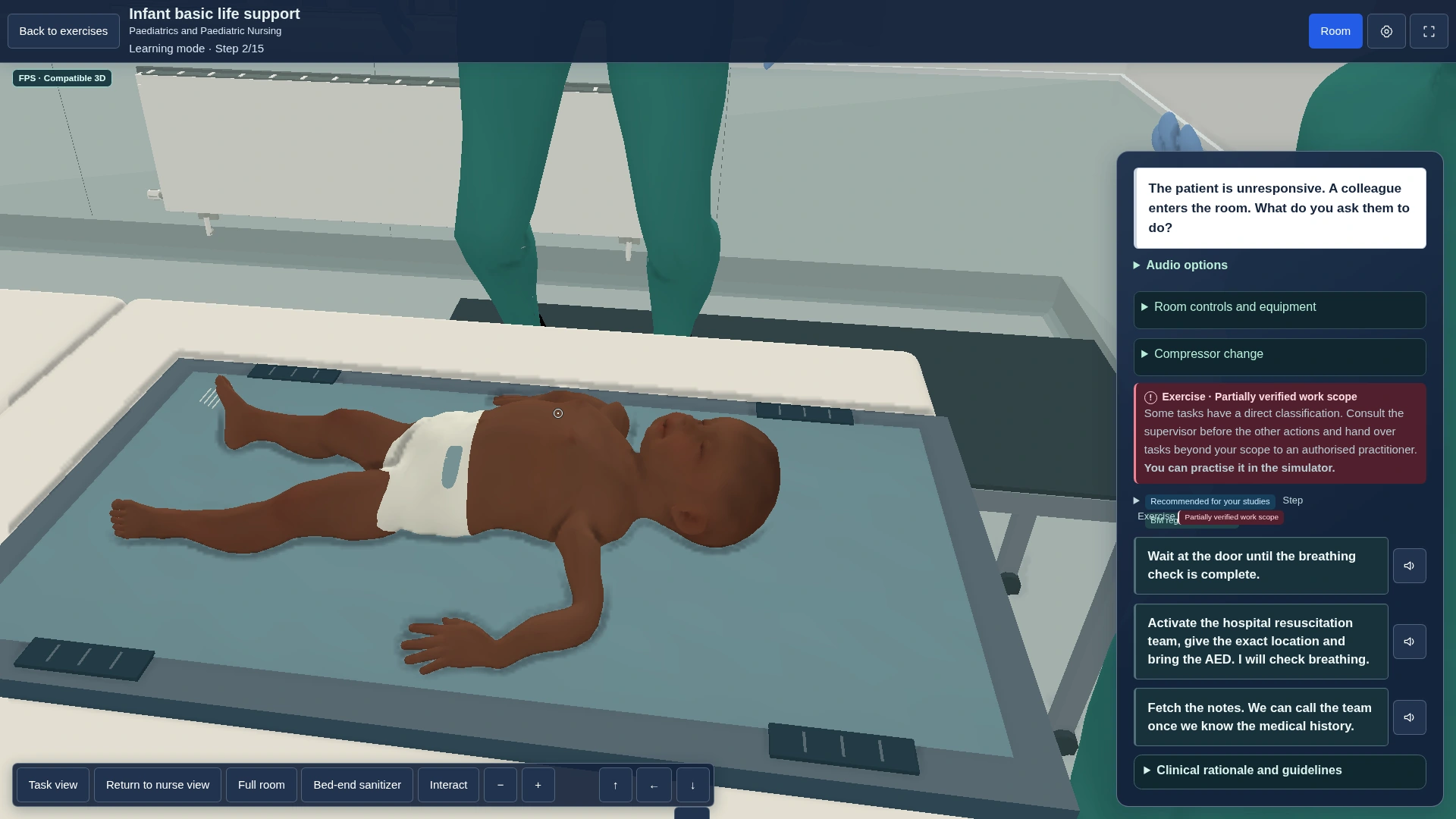
Related specialtiesThe eight-month-old infant is motionless. You assess responsiveness and breathing. One colleague calls for help and fetches the AED. Another holds the head in a neutral position and seals the mask with both hands. You give five initial bag breaths, then encircle the chest (thorax) and alternate fifteen two-thumb (pollex) compressions with two breaths. The returning colleague takes over compressions while you operate the AED in paediatric mode.
Related specialtiesThe patient is unresponsive. There are three of you, and the resuscitation team has been called. You prepare the AED. Your colleague at the head opens the airway and leans over the mouth and nose. They look for movement of the chest (thorax), listen for breathing and feel for airflow on their cheek for up to ten seconds. As soon as they report no normal breathing, your other colleague starts compressions. The rescuer at the head then seals the mask with both hands, and the compressor squeezes the bag during the pauses.
Related specialtiesStart care safely for a stable, fictional adult patient. Good preparation underpins every skills station.
Related specialtiesChoose the correct palpation site, assess pulse characteristics and record the full-minute sample.
Related specialtiesObserve breathing quality, symmetry and the overall clinical picture as well as respiratory rate.
Related specialtiesA reassuring number alone is insufficient: check the sensor and signal reliability too.
Related specialtiesPrepare the device, select the measurement method and document the site too.
Related specialtiesPractise quality control, fingerstick sampling, result reading and safe aftercare with a stable adult patient.
Related specialtiesIn this separate case, a breathing abnormality becomes apparent. Call for help when it is recognised; do not wait until the end of ABCDE.
Related specialtiesAssess heel pain in an adult patient on bed rest. Inspect the skin, select a pain scale, compare follow-up findings and respond to a change in the patient’s condition.
Related specialtiesNo scenarios match. Try another search or choose a different module.
This module is part of the curriculum. Its first playable case is planned.
Some scenarios belong to more than one specialty.Game modes
For nursing students, professionals practising their skills and educators guiding a session.
Understand each step
Follow the instructions. Clinical explanations and reference material guide you through the care sequence.
Build your confidence
Make your own decisions, open a reference when you need it and repeat the procedures.
Check your knowledge
Work independently with the case data. The assessment reviews your decisions and the tasks you performed.
Scope-of-practice labels refer to Hungarian regulations in every language. The release report records the review status of individual scenarios.
Online edition
Open the game on your computer, phone or tablet. There is no installer or language pack to download.

Hungarian, English and German content loads as you play. An internet connection is required; adjust the graphics settings in the game to suit your device.
Windows · macOS · Linux · Android · iPhone · iPad
The game is publicly available to play without signing in.
Export and import your save in the profile menu. Existing saves remain available at the same address in the same browser.
The development and verification record distinguishes implemented movements from checks actually performed.
Open the recordPlans include VR and AR support, AI-assisted patient conversations, new specialty-specific cases and more detailed character models. In planned disease-based cases, learners would interpret symptoms, measurements and test results, act within their scope of practice, and document how the patient’s condition changes.
NurseSimLab
Nursing experience, dedicated to learning.
Created by
BSc in Nursing
Student in the Advanced Practice Nurse MSc programme, Faculty of Health Sciences, Semmelweis University.
Semmelweis University · Faculty of Health SciencesAcademic supervisors
Vice-Dean for Clinical Relations, Head of the Department of Nursing
Department of Nursing, Faculty of Health Sciences, Semmelweis University
balogh.zoltan@semmelweis.huAcademic supervisors
Master Instructor
Department of Nursing, Faculty of Health Sciences, Semmelweis University
lorincz.attila@semmelweis.huThe creator’s student affiliation and the academic supervision described here do not constitute university, clinical or legal approval of the entire program or every scenario. The BSc is an awarded qualification; the MSc studies are ongoing.
About / Legal notice